
Keeping the lights on and the doors open for a private medical practice depends on one thing no one likes to talk about: getting paid. Collections are the result of numerous moving parts, including coding, authorizations, claims, payments, patient billing, and follow-up. Failure in any one area can result in revenue leakage.
According to the Medical Group Management Association (MGMA), nearly one in five claims is either denied, delayed, or underpaid. More than half of these issues could be prevented with stronger processes and procedures in place. In other words, weak collections are rarely the fault of a single careless staff member; they’re systemic problems rooted in outdated workflows, underinvestment in technology, and a lack of staff expertise.
At Inviveo, we’ve seen firsthand how revenue leakage impacts practice stability. Collections aren’t just about recovering dollars—they’re about sustaining growth, ensuring providers are fairly compensated, and maintaining the patient experience.
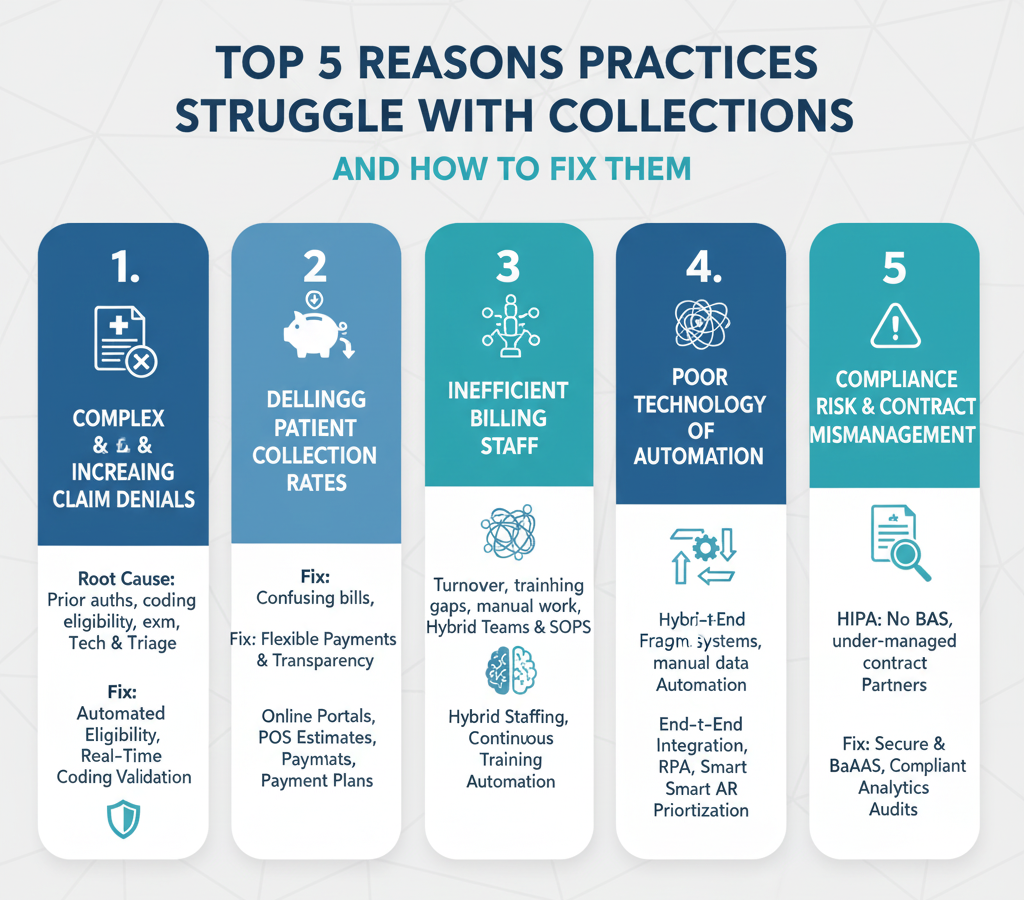
In this article, we’ll break down the top five reasons practices struggle with collections—and how to fix them. Along the way, we’ll share proven strategies, supported by automation, compliance, and hybrid staffing models, to help practices strengthen their revenue cycle.
1. Complex and Increasing Claim Denials
Claim denials are a significant source of lost revenue. Each denied claim represents work completed without payment, at least until it is appealed and overturned. For many practices, denials can feel like a frustrating cycle of back-and-forth with insurance companies.
Industry studies highlight the widespread nature of the problem with claim denials. According to Premier Inc., commercial payers initially deny about 15% of claims, often due to preventable issues like errors in prior authorization or patient eligibility. Similarly, a KFF analysis found that in 2023, nearly 1 in 5 (19%) of in-network claims were denied by ACA marketplace insurers.
For large providers, the financial implications are significant, with billions of dollars in expected revenue caught up in denials and appeals each year. For smaller private practices, even a denial rate of just 10–15% can disrupt cash flow and lead to difficult decisions, such as staff reductions or delaying investments in new technology or services.
Root Causes of Denials
Denials don’t happen randomly. They’re usually the result of one of a few predictable weak spots:
- Prior authorization failures occur when services are delivered without obtaining payer authorization.
- Coding inaccuracies: incorrect CPT or ICD-10 codes, or insufficient clinical documentation to justify medical necessity.
- Eligibility and benefit verification issues: providing care without confirming patient coverage.
- Timely filing or format errors: missing a payer’s submission deadline or formatting claims incorrectly.
- Frequent payer rule changes: staying compliant is an ongoing challenge, especially without dedicated staff monitoring updates.
Fixes: Operational + Tech
Fortunately, most denials are preventable with a disciplined approach:
- Front-End Eligibility & Authorizations: Automate eligibility checks at the time of scheduling or registration. Gate procedures until prior authorizations are confirmed. According to Experian’s State of Claims report, nearly half of denials could be prevented with stronger front-end verification.
- Real-Time Coding Validation & Clinical Documentation Improvement (CDI): Invest in software that cross-checks codes against chart documentation, flagging errors before submission. CDI tools ensure medical necessity is documented and codes are supported.
- Denial Triage Workflow: Not all denials deserve equal effort. Build a triage system:
- Prioritize high-dollar or high-success-rate denials for immediate appeal.
- Automate low-value denials with prebuilt templates.
- Routinely review denial categories to spot recurring issues.
- KPI Tracking: Track denial reasons on a monthly basis. Focus on the top two or three codes each quarter until they’re reduced. Over time, this creates a measurable downward trend.
Why Hybrid Outsourcing + Automation Works
Hybrid partners, such as Inviveo, combine technology with trained denial specialists. This powerful combination not only reduces human error before submission but also ensures that appeals are managed efficiently and effectively. The use of technology in revenue cycle management is a promising development, offering faster appeal turnaround times and higher overturn rates than traditional manual methods.
2. Patient Responsibility and Declining Collection Rates
The healthcare industry has undergone significant changes over the past decade. With high-deductible health plans becoming the standard, patients are now responsible for a larger portion of their medical costs than ever before. While this shift reduces risk for payers, it places increased financial pressure on healthcare providers.
Many patients struggle to pay their share or may not fully understand what they owe. As a result, collection rates from patients have declined dramatically. According to TechTarget, some providers report collection rates falling into the high 40s percentage range. In contrast, insurance carriers typically have near-100% expected payment rates, highlighting the impact unpaid patient balances can have on a practice’s cash flow.
Root Causes
- Confusing billing statements: jargon-heavy bills that leave patients unsure of what they owe.
- Opaque pricing: patients rarely receive accurate cost estimates before care.
- Limited payment options: no ability to pay via card, mobile wallet, or installment plan.
- Weak follow-up systems: overdue balances aren’t consistently pursued.
- Lack of financial counseling: patients don’t know about payment plans or hardship policies.
Fixes: Making Payments Easier for Patients
- Pay-at-Check-Out & Online Portals: Implement secure payment systems at the point of service (POS). Accept credit cards, HSA/FSA cards, and mobile wallets. Pair this with an online portal that lets patients view, manage, and pay their bills 24/7.
- Point-of-Service Estimates: Give patients a clear cost estimate before treatment. Automated eligibility and benefit verification tools make this possible. Patients are far more likely to pay when they know what to expect.
- Flexible Payment Plans: Offer interest-free installment plans with automatic payments. Even small, predictable amounts (e.g., $25 per month) improve recovery rates compared to all-or-nothing billing.
- Patient Financial Counseling: Train front-desk staff to explain balances and payment options compassionately. When patients feel supported, they’re more likely to cooperate rather than avoid payment.
Why It Works
Studies show patients are more likely to pay when billing is simple, transparent, and flexible. Practices that implement digital payment tools report higher collection rates and reduced bad debt write-offs.
3. Inefficient or Under-Trained Billing Staff
Billing is one of the most intricate aspects of running a medical practice. Each payer has its own rules, deadlines, and exceptions. For many small practices, billing is managed by a lean internal team that’s already stretched thin, often splitting their time between patient-facing responsibilities and back-office work.
Without specialized training, mistakes become inevitable. Claims slip through the cracks, follow-ups are delayed, appeals are missed, and write-offs accumulate. Instead of working within a streamlined process, staff end up putting out fires—reacting to denials and errors rather than preventing them from occurring.
The cost isn’t just financial. Inefficient billing can lead to staff burnout, slow down cash flow, and erode patient trust when billing errors impact their overall experience. Practices that fail to invest in well-trained billing support ultimately pay the price in lost revenue and higher turnover.
Root Causes
- Staff turnover leads to inconsistent workflows.
- Training gaps: Billers aren’t entirely up to date on payer policy changes.
- Reactive billing culture: staff focus only on aged claims, not prevention.
- Overreliance on manual processes like spreadsheets, faxing, and paper claims.
Fixes: Strengthen Your Billing Workforce
- Hybrid Staffing Model: Blend your in-house team with an outsourced partner like Inviveo. This preserves internal knowledge while adding surge capacity and specialized expertise for denials and appeals.
- Standard Operating Procedures (SOPs): Document billing workflows: days to bill, follow-up intervals, appeal turnaround times. SOPs keep the team consistent, even when staff turnover occurs.
- Continuous Training: Invest in regular coding updates and payer-specific training. Measure coder accuracy and audit claims on a regular basis.
- Leverage Technology: Provide billers with the right tools — integrated EHRs, claim scrubbing software, and KPI dashboards. The right systems reduce clerical work, allowing staff to focus on complex problem-solving.
Why Outsourcing Often Reduces Cost
Outsourcing billing doesn’t just solve expertise gaps — it often saves money. External vendors work at scale, spreading costs across multiple clients and staying current on payer changes. Instead of paying salaries, benefits, and training costs for a large in-house team, practices convert those expenses into performance-based fees.
According to Outsource Strategies International, outsourcing can reduce billing overhead by up to 30%, while simultaneously increasing net collections through improved accuracy and denial prevention.
Discover how outsourcing your practice billing to Inviveo can help you achieve a 99% first-pass claim acceptance rate and cut your accounts receivable days by 30%.
4. Poor Technology & Lack of Automation
Healthcare may be advancing rapidly in clinical care, but when it comes to billing and revenue cycle management (RCM), many practices are still stuck in the past. Some still rely on paper-based workflows, spreadsheets, and manual posting. The problem? Manual processes are slow, prone to errors, and expensive. Practices that fail to modernize risk being left behind, with longer days in accounts receivable (AR) and higher write-offs.
Root Causes
- Fragmented systems: Scheduling, EHR, billing, and payment systems don’t communicate with each other.
- Manual remittance posting: staff waste hours keying in data that could be automated.
- No automated patient engagement: missed opportunities for text/email reminders and easy payment links.
- Reactive AR management: staff chase balances manually rather than using automated prioritization.
Fixes: Bring in Smart Automation
- End-to-End Integration: Connect scheduling, eligibility verification, EHR, billing, and patient payments into a single streamlined workflow. This reduces duplicate data entry and lowers error rates.
- Automate Low-Level Tasks: Use robotic process automation (RPA) and AI to:
- Extract remittance data from payers.
- Apply payments automatically.
- Generate denial appeal drafts.
- Send automated patient reminders with embedded payment links.
- Smart AR Prioritization: Not all balances are created equal. AI-based scoring models can help staff prioritize accounts with the highest likelihood of payment, while automation handles repetitive, low-value claims.
- Measure the ROI: Monitor KPIs such as:
- Days in AR.
- Net collection rate.
- Denial rates.
- Cost to collect.
- Practices adopting automation often see measurable improvements within the first six months.
5. Compliance Risk & Contract Mismanagement
Collections don’t just depend on billing efficiency — they also hinge on compliance and payer contract integrity. Practices that fail to secure HIPAA-compliant billing partners or neglect payer contract monitoring risk revenue leakage, fines, and even legal penalties.
HIPAA regulations require practices to sign a Business Associate Agreement (BAA) with any vendor handling protected health information (PHI). Without one, the practice, not just the vendor, is exposed to liability. At the same time, payer contracts must be continuously monitored to ensure fee schedules are accurate and reimbursement rates are enforced.
In fact, the U.S. Department of Health and Human Services (HHS) has explicitly stated that covered entities are responsible for ensuring compliance when outsourcing billing. Failing to address this is a direct threat to financial and reputational stability.
Root Causes
- No executed BAAs with billing vendors or subcontractors.
- Weak cybersecurity and poor access controls at vendors.
- Under-managed payer contracts, leading to underpayments.
- Lack of compliance audits to ensure ongoing security and accuracy.
Fixes: Build Compliance Into the DNA
- HIPAA-Compliant Partners Only: Demand signed BAAs from all billing partners. Require proof of encryption, access logs, and incident response plans.
- Contract Analytics: Maintain a contract ledger. Use automated alerts to flag expired fee schedules, missing addenda, or under-reimbursement patterns.
- Periodic Compliance Audits: Require vendors to provide quarterly security posture reports. Conduct internal reviews to ensure compliance is ongoing, not a one-time checkbox.
- Secure Infrastructure: Insist that vendors use encrypted file transfer, secure cloud hosting, and strict user access controls.
How a Modern RCM Partner Differentiates (Inviveo Example)
Many practices assume all revenue cycle partners are the same, but that’s far from reality. The difference between a vendor that merely processes claims and a partner that actively drives growth can be drastic. A modern RCM provider combines technology, staffing, compliance, and measurable outcomes in ways that directly impact a practice’s bottom line.
Automation-First Approach
One hallmark of today’s best RCM partners is their ability to automate routine billing tasks. At Inviveo, for example, automation plays a central role: eligibility is verified automatically, claims are scrubbed in real time, and robotic process automation (RPA) posts remittances without delay. This reduces human error and accelerates the payment cycle. Instead of tying up staff with manual checks and rework, automation ensures cleaner claims and faster reimbursements.
Hybrid Staffing Support
Staffing challenges in billing are an ongoing issue for many practices. A modern RCM partner addresses this by providing flexible, skilled support that scales with demand. Inviveo’s model combines technology with experienced billers and coders who can adapt to fluctuations in volume. That means practices don’t need to absorb the cost and risk of constant hiring and training. Instead, they gain reliable access to the expertise required to keep revenue flowing smoothly.
Compliance as a Priority
With regulations tightening and penalties for breaches increasing, compliance is another area where a strong RCM partner makes a difference. Inviveo, for instance, operates with HIPAA-first protocols, signed BAAs, and routinely audited systems. This level of diligence enables practices to eliminate regulatory risk, maintain patient trust, and ensure that billing processes meet industry standards.
Results You Can Measure
Finally, a modern RCM partner should be transparent about performance. Inviveo provides KPI dashboards that track key metrics such as denial rates, net collection rates, days in AR, and cost-to-collect. By aligning services with measurable results — and even providing service-level guarantees — the focus shifts from “billing support” to genuine revenue enablement. In practice, this often means that clients recover more revenue than they spend on outsourcing, making the partnership a clear financial advantage.
Conclusion: The Path to a Healthier Practice
The financial health of a medical practice is directly tied to the efficiency of its collections. The five areas discussed in this article are not isolated problems but interconnected parts of a complex system. Neglecting any one of them can create a domino effect, leading to delayed payments, increased write-offs, and administrative headaches.
By embracing a strategy that combines modern technology with skilled staff, practices can move beyond simply collecting what’s owed. They can establish a predictable and resilient revenue stream that supports their mission of delivering exceptional patient care. This isn’t just about recovering dollars; it’s about sustaining growth and ensuring providers are fairly compensated for their vital work.
The Next Step for Your Practice
Are you ready to stop the revenue leakage in your practice? Don’t let outdated processes and preventable denials hold you back. Take the first step toward a healthier revenue cycle today.
Click here to schedule a free consultation with an Inviveo expert and discover how our hybrid staffing and automation solutions can reduce your denial rate and improve your cash flow.
